
West Virginia weather and outdoor projects
West Virginia is mountainous, and elevation shapes the weather. Charleston in the Kanawha Valley has warm, humid summers and fairly mild winters, while Elkins and the higher mountains are cooler and wetter, with an earlier frost and a shorter season.
Valley fog is common on calm mornings and can keep surfaces wet until late morning, so wait for it to clear before painting or staining. Late spring and September are the best months for most projects. Freeze-thaw cycles are frequent in winter, especially at higher elevations.
Frost dates in West Virginia
In Charleston, the median last spring freeze (32°F) is around April 16 and the median first fall freeze is around October 26, a frost-free season of about 192 days.
In Elkins, the median last spring freeze (32°F) is around May 5 and the median first fall freeze is around October 12, a frost-free season of about 159 days.
How West Virginia compares with other states
Charleston is tied for the shortest deck staining season of the 50 state main stations (2 good months). Charleston is tied for the most rainy days of the 50 state main stations (93 a year with 0.1 in or more). Charleston has the 9th-most humid summer afternoons of the 47 state main stations (54% humidity at 3 PM, June–August).
| Measure (Charleston) | Value | Rank, highest first |
|---|---|---|
| Deck staining season | 2 good months | 46th of 50 |
| Frost-free season | 192 days | 33rd of 50 |
| Freezing nights | 94 a year | 23rd of 50 |
| Rainy days | 93 a year with 0.1 in or more | 1st of 50 |
| Days at 90°F or hotter | 24 a year | 28th of 50 |
| Summer afternoons | 54% humidity at 3 PM, June–August | 9th of 47 |
Best time to stain a deck in West Virginia
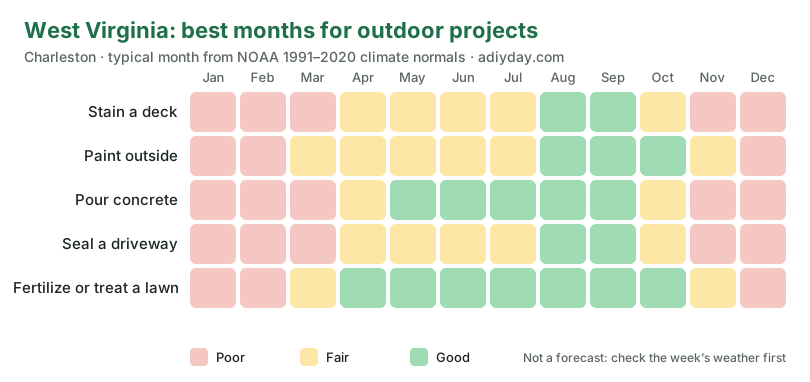
In Charleston, the most reliable months are August–September. April–July and October can also work on the right days. December–February is too cold, with average highs around 46°F. In March and November, nights average about 35°F, too cold for the coating to dry and cure overnight. In April and October, nights average about 45°F, so finish early on mild days and check the overnight low. May–July averages about 9 wet days a month, so wait for a clear stretch.
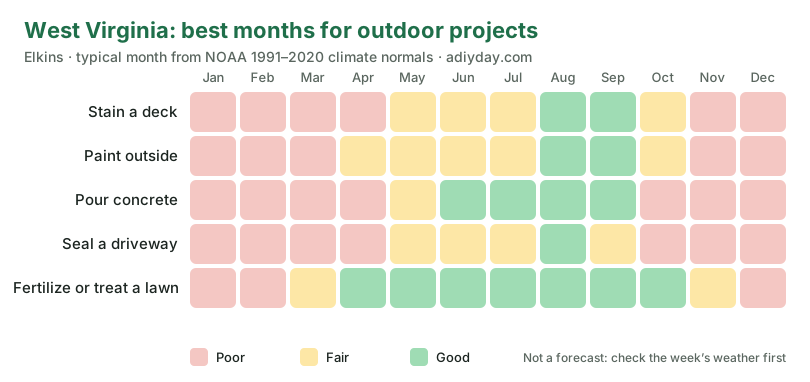
In Elkins, the most reliable months are August–September. May–July and October can also work on the right days. November–March is too cold, with average highs around 48°F. In April, nights average about 37°F, too cold for the coating to dry and cure overnight. In May and October, nights average about 43°F, so finish early on mild days and check the overnight low. June–July averages about 10 wet days a month, so wait for a clear stretch.
Best time to paint outside in West Virginia
In Charleston, the most reliable months are August–October. March–July and November can also work on the right days. December–February is too cold, with average highs around 46°F. March and November are cool, with highs around 57°F, so choose the warmest afternoons. In April, nights average about 45°F, so finish early on mild days and check the overnight low. May–July averages about 9 wet days a month, so wait for a clear stretch.
In Elkins, the most reliable months are August–September. April–July and October can also work on the right days. December–February is too cold, with average highs around 44°F. In March and November, nights average about 29°F, too cold for the coating to dry and cure overnight. In April and October, nights average about 38°F, so finish early on mild days and check the overnight low. May–July averages about 10 wet days a month, so wait for a clear stretch.
Best time to pour concrete in West Virginia
In Charleston, the most reliable months are May–September. April and October can also work on the right days (average highs Apr 69°F, Oct 69°F). November–March averages about 18 nights a month at or below 32°F, so fresh concrete needs blankets or heated enclosures. April and October bring about 3 freezing nights a month, so pick a mild spell and keep curing blankets on hand.
In Elkins, the most reliable months are June–September. May can also work on the right days (average highs May 73°F). October–April averages about 19 nights a month at or below 32°F, so fresh concrete needs blankets or heated enclosures. May brings about 2 freezing nights a month, so pick a mild spell and keep curing blankets on hand.
Best time to seal a driveway in West Virginia
In Charleston, the most reliable months are August–September. April–July and October can also work on the right days. November–March is too cold, with average highs around 51°F. In April and October, nights average about 45°F, so finish early on mild days and check the overnight low. May–July averages about 9 wet days a month, so wait for a clear stretch.
In Elkins, the most reliable months are August. May–July and September can also work on the right days. November–March is too cold, with average highs around 48°F. In April and October, nights average about 38°F, too cold for the coating to dry and cure overnight. In May and September, nights average about 49°F, so finish early on mild days and check the overnight low. June–July averages about 10 wet days a month, so wait for a clear stretch.
Best time to fertilize or treat a lawn in West Virginia
In Charleston, the most reliable months are April–October. March and November can also work on the right days (average highs Mar 57°F, Nov 57°F). December–February is too cold, with average highs around 46°F. March and November are cool, with highs around 57°F, so choose the warmest afternoons.
In Elkins, the most reliable months are April–October. March and November can also work on the right days (average highs Mar 54°F, Nov 55°F). December–February is too cold, with average highs around 44°F. March and November are cool, with highs around 54°F, so choose the warmest afternoons.
How the weather differs across West Virginia
| Place | Hottest month avg high | Coldest month avg low | Rain per year | Last spring freeze | First fall freeze |
|---|---|---|---|---|---|
| Charleston | 86°F | 26°F | 46 in | April 16 | October 26 |
| Elkins | 83°F | 20°F | 47 in | May 5 | October 12 |
Of the places above, Charleston has the most good months for staining, painting and concrete combined (10 job-months), and Elkins has the fewest (8).
Monthly weather in Charleston
| Month | Avg high | Avg low | Wet days* | Rain | 3 PM humidity | Freezing nights |
|---|---|---|---|---|---|---|
| January | 44°F | 26°F | 8 | 3.3 in | 57% | 23 |
| February | 48°F | 29°F | 8 | 3.4 in | 52% | 19 |
| March | 57°F | 35°F | 9 | 4.1 in | 45% | 14 |
| April | 69°F | 45°F | 8 | 3.6 in | 40% | 4 |
| May | 76°F | 53°F | 9 | 4.9 in | 49% | 0 |
| June | 83°F | 62°F | 9 | 4.7 in | 53% | 0 |
| July | 86°F | 66°F | 9 | 5.4 in | 54% | 0 |
| August | 85°F | 64°F | 6 | 3.8 in | 54% | 0 |
| September | 80°F | 57°F | 6 | 3.5 in | 51% | 0 |
| October | 69°F | 45°F | 7 | 2.9 in | 48% | 2 |
| November | 57°F | 36°F | 6 | 3.2 in | 48% | 13 |
| December | 48°F | 30°F | 8 | 3.6 in | 57% | 20 |
*Days with 0.1 inch of rain or more; column notes.
Monthly weather in Elkins
| Month | Avg high | Avg low | Wet days* | Rain | 3 PM humidity | Freezing nights |
|---|---|---|---|---|---|---|
| January | 42°F | 20°F | 8 | 3.4 in | 58% | 26 |
| February | 45°F | 22°F | 8 | 3.3 in | 52% | 23 |
| March | 54°F | 29°F | 10 | 4.0 in | 45% | 21 |
| April | 66°F | 37°F | 10 | 4.1 in | 41% | 10 |
| May | 73°F | 47°F | 11 | 5.1 in | 48% | 2 |
| June | 80°F | 56°F | 9 | 4.5 in | 54% | 0 |
| July | 83°F | 60°F | 10 | 6.0 in | 56% | 0 |
| August | 82°F | 58°F | 8 | 3.9 in | 55% | 0 |
| September | 77°F | 52°F | 7 | 3.5 in | 52% | 0 |
| October | 66°F | 39°F | 7 | 3.1 in | 48% | 9 |
| November | 55°F | 30°F | 7 | 2.9 in | 49% | 20 |
| December | 45°F | 24°F | 9 | 3.6 in | 57% | 25 |
Source: NOAA NCEI U.S. Climate Normals 1991–2020 for CHARLESTON YEAGER AP, ELKINS RANDOLPH CO AP. See how the ratings work and how late in fall you can stain, paint or seal.
Frequently asked questions
When is the best time to stain a deck in West Virginia?
In Charleston, August–September. In Elkins, August–September.
When is the last frost in West Virginia?
Charleston: around April 16; Elkins: around May 5.
Can you pour concrete in winter in West Virginia?
Yes, with cold-weather practices: Charleston averages about 62 freezing nights from December to February, so fresh concrete needs insulated blankets, a heated enclosure or an accelerated mix, and must not freeze in the first 48 hours. Many homeowners wait for spring.
What months are best for sealing a driveway in West Virginia?
In Charleston, August–September. In Elkins, August.