
Outdoor DIY Weather Timing: How Temperature, Dew and Rain Decide Whether a Project Lasts
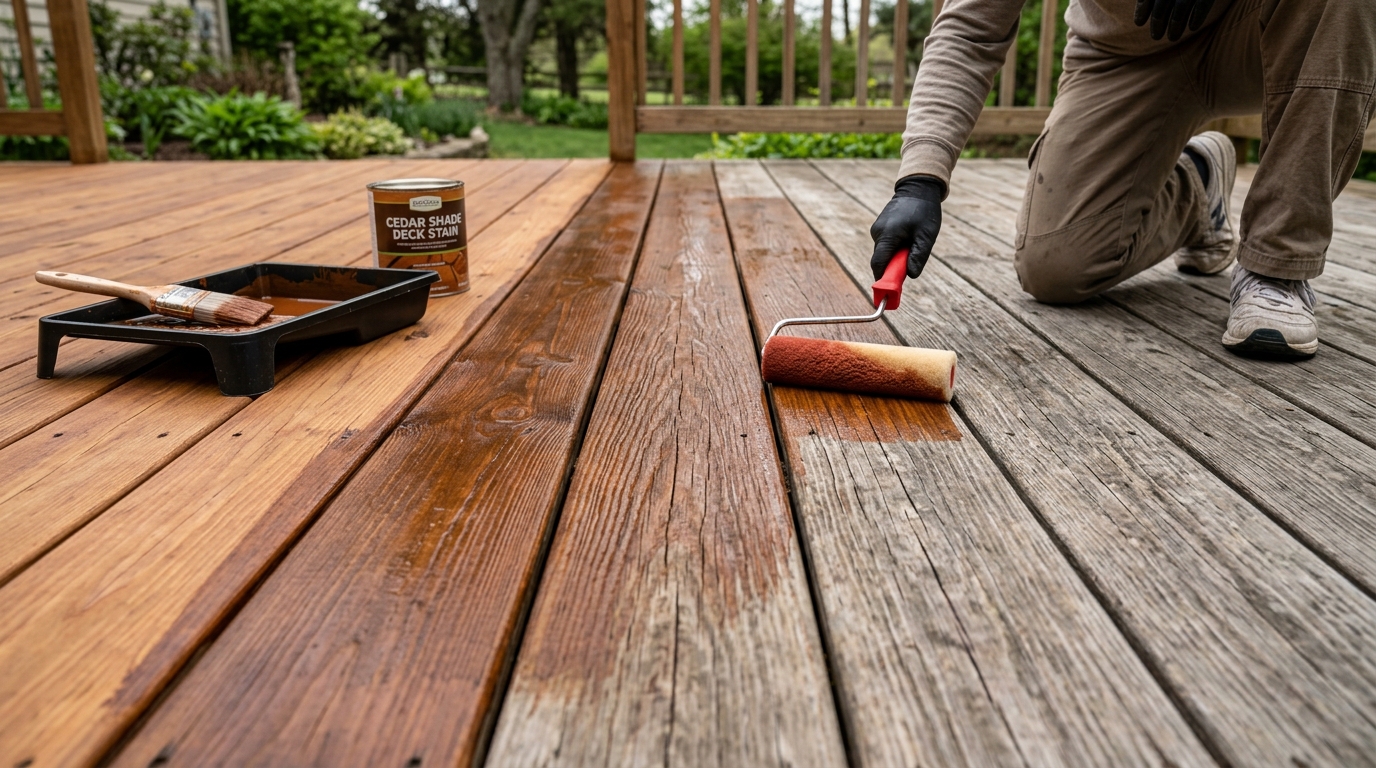
Peeling deck stain, streaky paint, a cracked slab and driveway sealer running down the gutter usually have the same cause: the job was done on the wrong day. The product was fine, but the weather during or just after the work wasn’t. This guide covers the five weather factors that matter, the limits for ten common projects, and a routine for choosing the day.
Why a nice day can still be the wrong day
A weather app answers “what will it feel like outside?” A coating or a slab asks different questions. Will the surface stay dry until the finish has soaked in? Will the temperature stay above the product’s minimum overnight, not just at noon? Will dew form on the surface at 7 PM? Is it so dry and windy that the concrete loses its water before it can harden?
Most of these risks come after you put the brush down. A 72°F Saturday afternoon is perfect for staining, unless rain arrives before morning or the temperature drops into the 30s overnight. That is why each forecast on this site checks the work window and the hours after it.
The five weather factors
1. Temperature, in the air and on the surface
Every coating, sealer and mix has a minimum application temperature on the label, commonly 50°F for stain, standard latex paint, epoxy and driveway sealer, 40°F for many caulks and concrete, and 35°F for low-temperature paints. Below that the product dries slowly or not at all, and the film can end up weak.
The label usually means the surface temperature as well as the air. Surfaces can be very different from the forecast: dark boards and asphalt in full sun get much hotter than the air, and siding in shade or a concrete slab after a cold night can be several degrees colder. An inexpensive infrared thermometer settles the question. Too hot is a problem too: stain and paint on a sun-baked surface can dry before they soak in or level out, leaving lap marks.
Temperature also has to hold. Paint may be applied at 55°F, but if the night falls to 38°F it cures slowly and may not form a proper film. Where it matters, the forecast checks the temperature after you finish too: for 8 hours after painting, 12 after staining, 24 after sealing a driveway or coating a garage floor, and up to 72 after a concrete pour.
2. Humidity
Water-based products dry by evaporation, and humid air slows it. That usually means a longer wait before rain or recoating rather than a failure, but very high humidity (above about 85%) can leave paint soft for hours, turn spray paint cloudy, and slow epoxy. The opposite extreme matters for concrete: very dry air, together with heat and wind, pulls water from the surface too fast.
3. Dew point
The dew point is the temperature at which the air’s moisture starts to condense. When a surface cools to the dew point, water forms on it, even with no rain in the forecast. That is how fresh paint gets streaks of sticky residue (surfactant leaching) and epoxy turns cloudy.
A common rule on paint and coating data sheets is to keep the surface at least 5°F above the dew point while you work and while the finish sets. On clear, calm evenings, the air cools toward the dew point quickly after sunset, and roofs, decks and cars cool even faster. In spring and fall that can happen by early evening, which is why painters stop early in the afternoon at those times of year. See our dew point guide for more.
4. Wind
Wind cuts both ways. A light breeze helps paint and stain dry. Strong or gusty wind blows dust into wet finishes, carries overspray onto cars and plants, and dries concrete too fast. For weed killer, dead-calm air is a risk as well: cool, still air near the ground can hold a fine mist and move it sideways, so many labels ask for a steady 3 to 10 mph breeze.
5. Rain before and after
Rain before the job leaves the wood, concrete or asphalt wet. Stain and sealer need dry pores to soak into, so a deck needs a day or more of drying after heavy rain. Rain after the job is the obvious risk: it washes off stain, spots paint, pits fresh concrete and carries driveway sealer into the street. Each product has a rain-safe time on its label, from about an hour for some “rain-ready” paints to 24 to 48 hours for many deck stains and driveway sealers.
Forecast rain chances are probabilities, not promises. A 30% chance of rain for the hour means a 30% chance of measurable rain at your location in that hour. Our guide to what the chance of rain means explains how to use it.
The limits for ten common projects
These are the limits the forecasts on this site check. They reflect typical product labels and published guidance. The label on the product you buy can be stricter or looser, and it always wins.
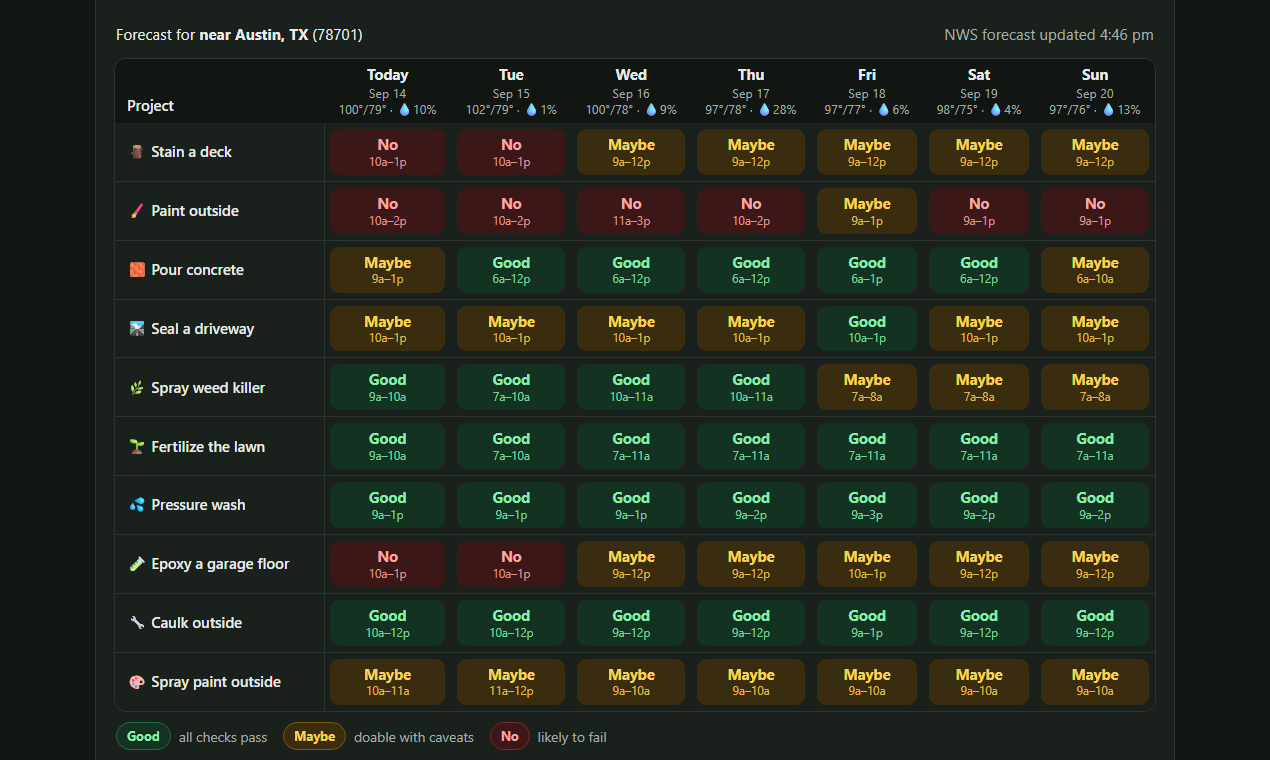
| Project | Temperature while working | After you finish | Other checks |
|---|---|---|---|
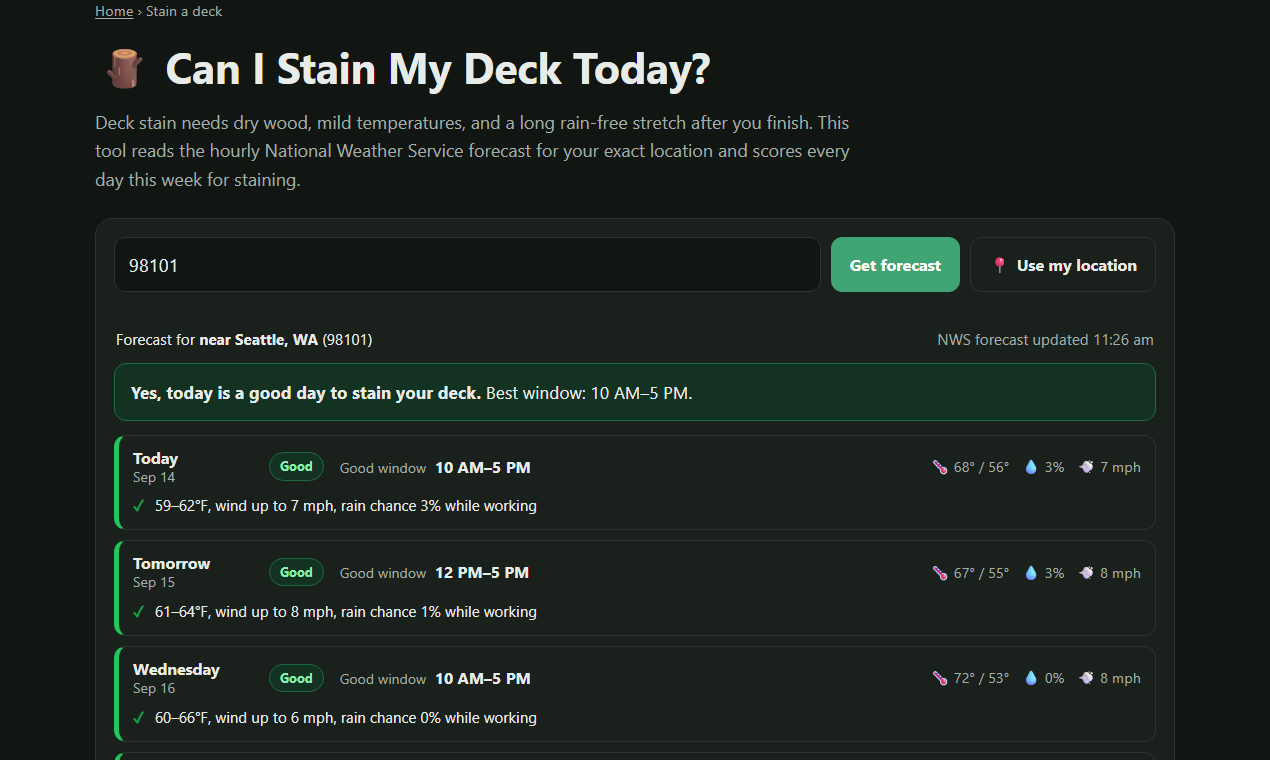
| Stain a deck | 50–90°F | 40°F+ for 12 h; no likely rain for 24 h; no dew for 4 h | 5°F+ above dew point; humidity ≤ 85%; wind ≤ 15 mph; dry 24 h before |
| Paint outside | 35–90°F | 35°F+ for 8 h; no likely rain for 12 h; no dew for 4 h | 5°F+ above dew point; humidity ≤ 85%; wind ≤ 15 mph; dry 24 h before |
| Pour concrete | 40–100°F | 33°F+ for 48 h; no likely rain for 8 h | wind ≤ 30 mph; evaporation < 0.2 lb/ft²/h |
| Seal a driveway | 50–95°F | 50°F+ for 24 h; no likely rain for 24 h | humidity ≤ 90%; wind ≤ 25 mph; dry 24 h before |
| Spray weed killer | 45–90°F | no likely rain for 6 h | wind 3–10 mph; dry 3 h before |
| Fertilize the lawn | 40–95°F | light rain within 48 h is a bonus; 1"+ in a day is a no-go | wind ≤ 20 mph |
| Pressure wash | 40–105°F | ideally 32°F+ for 12 h | wind ≤ 25 mph |
| Epoxy a garage floor | 50–90°F | 45°F+ for 24 h | 5°F+ above dew point; humidity ≤ 85% |
| Caulk outside | 40–100°F | no likely rain for 6 h | 5°F+ above dew point; wind ≤ 25 mph; dry 12 h before |
| Spray paint outside | 50–90°F | no likely rain for 6 h | 5°F+ above dew point; humidity ≤ 85%; wind ≤ 10 mph |
Each project page explains its limits in more detail: why deck stain needs dry wood, why concrete worries about evaporation, why fertilizer wants light rain, and so on.
How reliable is a 7-day forecast?
Forecasts are most reliable for the next one to three days. Beyond that, the timing of rain and cold fronts often shifts by hours or a day. Use days four to seven to shortlist likely days, and confirm the day before. Hourly details, such as when rain arrives or how fast the temperature falls in the evening, are the part most likely to change.
A forecast also describes an area, not your yard. The National Weather Service grid is about 2.5 km across. A deck under trees, a north wall, a valley that collects cold air or a spot near a lake can be quite different from the forecast. Your own eyes and a thermometer on the day matter.
A weekend planning routine
- Five to seven days out: check the project forecast for your ZIP code and pick the one or two days that look best. Order materials if you need to.
- Two days out: check again. If rain has moved onto your chosen day or the night before, switch days now. For stain and sealer, make sure the day before is dry too.
- The day before: confirm the verdict and the best start time. Prepare the surface: clean, scrape, mask, and move furniture.
- The morning of: check that dew has burned off and the surface is dry. Test wood with the water drop test. Check the surface temperature if it is cool or very sunny.
- While you work: finish with time to spare before the evening dew. Keep a tarp or plastic sheeting handy for concrete or a small painted area in case a shower comes early.
Common mistakes
- Staining after a wet week: the surface looks dry after a sunny morning but the boards are still wet inside. See is your deck dry enough to stain?
- Painting late on a fall afternoon: the paint is still soft when dew forms at dusk.
- Pouring concrete on a hot, windy afternoon: the surface dries and cracks before it can be finished. Pour early in the morning instead.
- Sealing a driveway too late in the year: the sealer needs about 50°F or more for a day or so after you finish, and cold nights stop it curing. See how late in the fall you can stain, paint or seal.
- Spraying weeds on a still evening: calm, cooling air can carry fine droplets further than a light breeze.
The label comes first
Every figure in this guide is a typical value. Products differ: a low-temperature paint can go on at 35°F, a fast-set concrete mix behaves differently from a standard bag, and an oil stain may need longer before rain than a water-based one. Read the label and the technical data sheet, and treat the forecast as a way to find the days that meet them.
Frequently asked questions
What is the lowest temperature for staining a deck?
Most deck stains ask for at least 50°F in the air and on the wood, and for it to stay above that while the stain dries, often 12 to 24 hours. A few low-temperature products go down to about 35 to 40°F. The label on your stain is the rule.
How long does exterior paint need before rain?
Standard exterior latex usually needs about 4 to 8 dry hours in mild weather before light rain won’t damage it, and longer when it is cool or humid. Some “rain-ready” paints claim an hour under ideal conditions. Oil-based paint often needs 12 to 24 hours.
Can I pour concrete if it will freeze overnight?
Only with protection. Fresh concrete must not freeze before it reaches about 500 psi, which usually takes about two days in cool weather. Insulated curing blankets, a cold-weather mix and warm ground make a small pour possible, but it is simpler to wait for a forecast that stays above freezing.
Is a 40% chance of rain too high for my project?
It depends on how much damage rain would do and when it would fall. For stain, paint or sealer that needs a long dry period, a 40% chance in the hours after you finish is a real risk. The A DIY Day forecasts treat 30% as a caution and 50% as likely rain.
Why does the forecast say No on a sunny day?
Usually because of what happens after you finish: a cold night, dew in the evening, or rain the next morning. The verdict lists the exact reason and the hour it applies to.
Check the forecast for your project
Enter your ZIP code to see which of the next 7 days fit, hour by hour: stain a deck, paint outside, pour concrete, seal a driveway.